RR&R
Reimagining Rehabilitation and Resettlement
Understanding what works in rehabilitation and resettlement
For more than 13 years, LandWorks has been supporting people in prison, people leaving prison and those serving community sentences to rebuild their lives through meaningful work, practical support and positive relationships. During that time, more than 300 people have taken part in the programme, with strong evidence of positive outcomes including low rates of reoffending and high rates of employment.
Alongside this work, LandWorks has developed a longstanding research partnership with the University of Plymouth. This has generated more than a decade of research and learning about rehabilitation, resettlement and desistance. It includes the Photographic electronic Narrative (PeN) project, which began in 2016 and developed a substantial body of longitudinal qualitative research with people involved with LandWorks, alongside wider research and evaluation undertaken since LandWorks was established in 2013.
The Reimagining Rehabilitation and Resettlement (RR&R) project builds on this research and brings together existing evaluation data, Ministry of Justice analysis, interviews with trainees, graduates, staff and partners, and more than a decade of learning from LandWorks’ work in South Devon.
The project is exploring an important question:
What is it about the LandWorks approach that helps people make lasting positive changes in their lives?
The aim is not simply to identify whether LandWorks works, but to understand how and why its approach works, and what can be learned from it. The research is also exploring how this learning might be shared, adapted or applied in other communities and settings, including to replicate the LandWorks model elsewhere.
What has the research found so far?
One of the clearest findings is that positive change does not come from a single programme or intervention. Instead, the research suggests that it is the way different elements of the LandWorks approach work together that creates the conditions in which people can make and sustain positive changes in their lives.
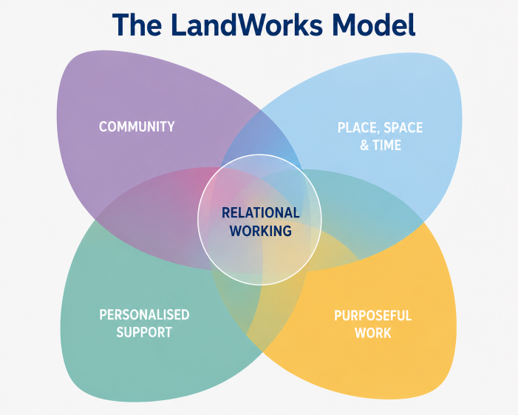
The emerging ‘LandWorks Model’ is organised around four interconnected domains, held together by ‘Relationally Informed Working’. The research suggests that it is the way these domains are connected and enacted through relationships that creates the conditions for positive and lasting change.
Relationships at the heart
At the heart of the LandWorks approach is Relationally Informed Working. Rather than being a separate intervention or programme element, it is the relational ethos through which the four main elements of the LandWorks Model are enacted. Trust, dignity, respect and genuine human connection shape how people work together and how support is provided.
Place, space and time
LandWorks provides a welcoming, non-institutional environment where people can feel safe, valued and able to participate at their own pace.
The research highlights the importance of having both the physical and emotional space to rebuild confidence, as well as the time needed for meaningful change to develop. The setting, routines and pace of LandWorks create opportunities for people to develop relationships, try new things and gradually build confidence.
Purposeful work
Participants undertake real and meaningful work that contributes to LandWorks and the wider community. This includes activities such as the wood workshop, pottery, market garden, kitchen, shop and grounds and building work.
The research suggests that purposeful work can provide much more than skills and experience. It creates routine, responsibility, achievement and opportunities for people to work alongside others and develop relationships naturally.
Personalised support
People arriving at LandWorks may be facing a range of challenges, including difficulties with housing, finances, employment, relationships or social isolation.
The research highlights the importance of support being responsive to the individual rather than treating everyone in the same way. Practical and personal support is embedded within trusted relationships, enabling people to address immediate challenges while also working towards longer-term goals.
Community and belonging
A sense of community and belonging runs throughout the LandWorks experience. People work alongside one another, share meals and activities, contribute to the running of the site and become part of a wider community.
For many, that connection continues after their placement. Graduates return as volunteers, mentors and supporters and maintain relationships with people they met at LandWorks.
The research suggests that belonging is not simply an outcome of rehabilitation. Being part of a supportive community can itself help create and sustain positive change.
What happens next?
The next phase of the RR&R project will build on these findings and focus on four main areas. The project team will:
- Refine and test the emerging LandWorks Model, drawing on evidence and the experiences of people who have been involved with LandWorks.
- Explore the organisational conditions that enable the approach to work, including leadership, culture, workforce development, reflective practice and governance.
- Examine how the learning could be shared, adapted or replicated, exploring different pathways including partnerships, practitioner development, organisational support and knowledge exchange.
- Develop a better understanding of impact and value, including cost-benefit and social value analysis.
The project recognises that extending the impact of LandWorks does not necessarily mean simply creating new LandWorks sites. Different communities and organisations may require different approaches. RR&R will therefore explore how the principles and learning from LandWorks might inform practice in other settings while recognising the importance of local context.
Get involved
RR&R is helping to build a deeper understanding of what effective long-term rehabilitation and resettlement can look like, and of the conditions that enable people to make positive and lasting changes in their lives.
We are keen to hear from practitioners, researchers, policymakers, funders and organisations interested in rehabilitation, resettlement, desistance, relational approaches and community justice.
If you would like to learn more about the project, discuss collaboration opportunities, share your experience or receive updates on the research, please get in touch with the LandWorks team via the contact page.
Together, we can help to build a stronger evidence base for rehabilitation and resettlement that supports lasting change for individuals, families and communities.